![TAI_LOGO_CMYK Option 1.2-03.jpg]](https://learn.tai-software.com/hs-fs/hubfs/TAI_LOGO_CMYK%20Option%201.2-03.jpg?height=40&name=TAI_LOGO_CMYK%20Option%201.2-03.jpg)
What this does
Shipment Stop Alerts let you attach a specific alert to an individual stop on a shipment, a pickup, a delivery, or an intermediate stop, rather than the shipment as a whole. Each stop carries its own active and resolved alerts independently, giving you precise visibility into what needs attention at each location on the route.
- Scope alerts to the exact stop where they are needed, not the whole shipment.
- Track resolution per stop, active and resolved alerts are shown separately at each stop.
- Customers can view stop alerts in real time in the Front Office customer portal.
- Automate stop alert creation and resolution using Workflow Automation.
- Report on stop alerts across all shipments using Custom Reports.
Before you start — what you need first
Stop alert types must be configured by an admin before they can be used.
How to configure stop alert types
Where to go: Back Office → LSP → Shipment Alerts.
- Each alert type has an Is Stop checkbox. Enable this to make the alert available for use as a stop-level alert.
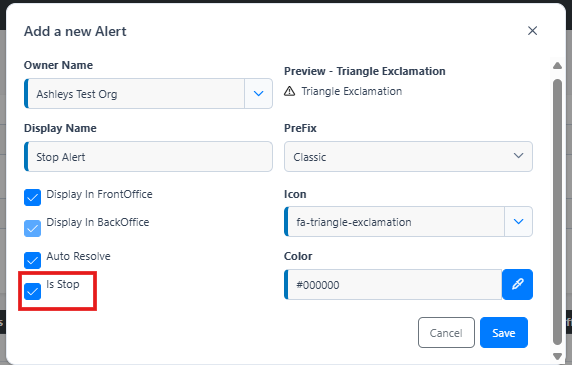
- Alert types with Is Stop unchecked remain available as shipment-level alerts only, they will not appear in the stop alert selector.
- You can have the same alert type serve as both a shipment-level and a stop-level alert by enabling Is Stop.
How to add a stop alert in the Shipment Detail
Where to go: Back Office → Shipments → open a shipment → scroll to the stops grid.
- In the stops grid, each stop has a bell icon to set up or view stop alerts. Click it to open the Stop Alerts modal for that stop.

- The modal shows a preview of the selected stop, address and contact information, so you can confirm you have the right stop. From there, use the dropdown or the + icon to select and add a stop alert type. Only alert types with Is Stop enabled appear in the selector. If an active alert already exists on the stop, it is shown with its creation date, an option to resolve it, and a trash icon to delete it. Resolved alerts are also shown in the modal for reference.
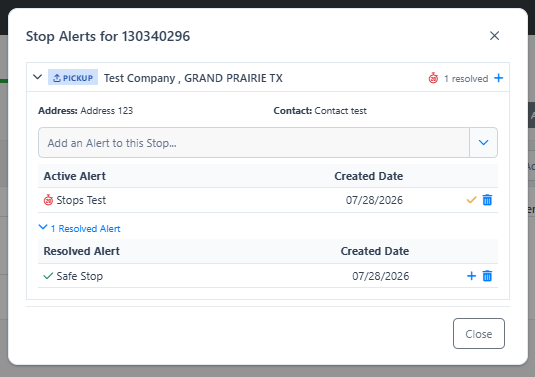
- Alternatively, click the pencil icon on a stop to open the Edit Stop modal. A stop alerts section is available at the bottom of that modal, where you can add or manage alerts the same way.
- You can add multiple stop alerts to the same stop.
Note: Only active alerts are shown in the stop card on the stops grid. Resolved alerts are not visible there, to see them, click the bell icon or the pencil icon on the stop and look for the resolved alerts section inside the modal.
How to resolve a stop alert in your shipment
Where to go: Back Office → Shipments → open a shipment → stops grid.
- Via the bell icon: Click the bell icon on the stop with the active alert. In the modal, find the active alert, it shows the creation date alongside a resolve check and a trash icon. Click the resolve check to mark it as resolved.
- Via the pencil icon: Click the pencil icon on the stop to open the Edit Stop modal. Scroll to the bottom to find the stop alerts section. Locate the active alert and select the resolve option next to it.
- The alert moves to a resolved state and is shown with a RESOLVED label. It remains visible in the stop's history.
How to view stop alerts in the Front Office (customers)
Where to go: Front Office → Shipments → open a shipment → scroll to the Origin or Destination stop card.
- Each stop card shows a Stop Alerts section listing any alerts for that stop.
- Active alerts are shown with a colored icon and the alert name.
- Resolved alerts are shown with a greyed icon and a RESOLVED badge.
- The Front Office view is read-only. Customers cannot add or resolve stop alerts.
- In the Shipments list, use the column customization option to add the Stop Alerts column to the grid. This lets you see at a glance which shipments have active stop alerts without opening each one individually. The Stop Alerts column can also be exported to Excel.
Applies to: The updated customer portal only. Stop alert visibility in the Front Office is available in the new version of the customer portal, it is not available in the legacy Front Office.
How to view stop alerts in the Back Office Shipment Search and Company Loadboard
Shipment Search — Where to go: Back Office → Shipments → Shipment Search.
Company Loadboard — Where to go: Back Office → Shipments → Company Loadboard.
- Use the column customization option to add the Stop Alerts column to the grid. The column shows an icon for shipments that have active stop alerts on any stop.
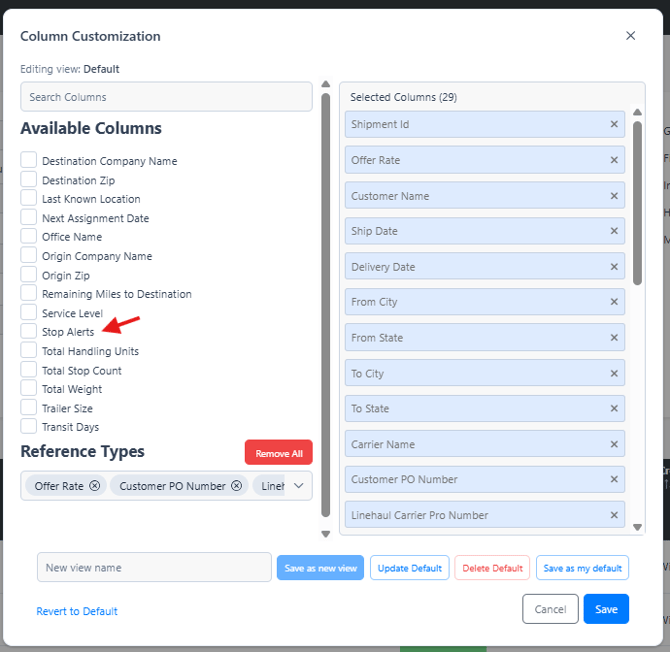
- Click on the bell icon or the active alert icon on a row to open the stop alert modal and manage alerts for that shipment's stops.
- Use the Alerts field in the search filters to find shipments that have a specific stop alert active.
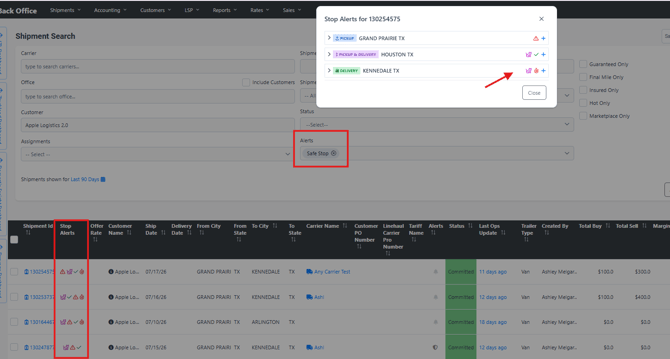
- The Stop Alerts column is included when you export to Excel — alert names appear as comma-separated text in the exported file.
How to use stop alerts in Workflow Automation
Where to go: Back Office → LSP → Workflow Automation → create or edit a workflow.
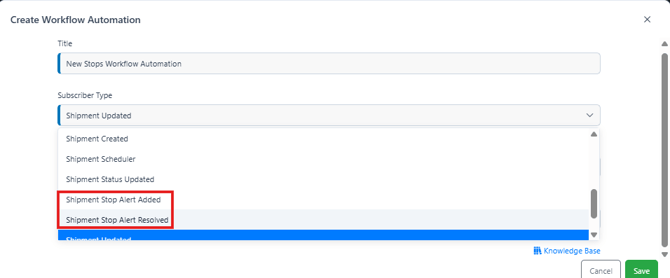
- Triggers: A workflow can fire when a stop alert is added (Shipment Stop Alert Added) or when a stop alert is resolved (Shipment Stop Alert Resolved).
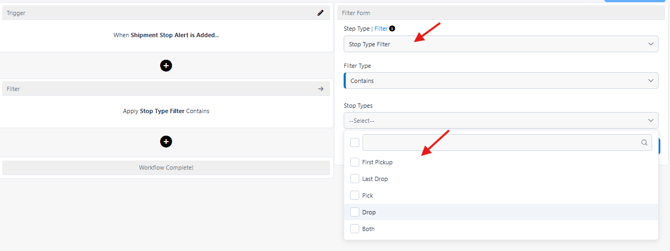
- Filters: Narrow the trigger by stop type using the Stop Type Filter (First Pickup, Last Drop, Pick, Drop, Both) 0r by alert type using the Stop Alert Filter.
The Stop Alert Filter checks for the named alert on the stop at the time the workflow fires, including the alert just added as the trigger. Use it when you want a workflow to fire only when a specific alert type is added, not any alert.
The filter supports two modes: Contains: the workflow fires only if the named alert is present on the stop; Does Not Contain: the workflow fires only if the named alert is absent from the stop
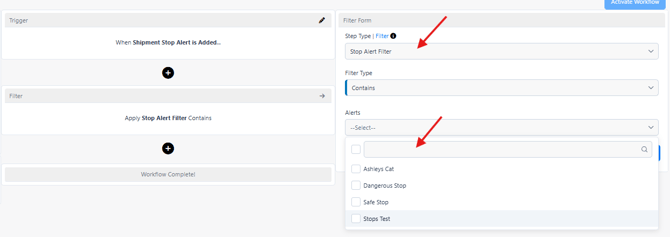
- For the Shipment Stop Alert Resolved trigger, use the Resolved Stop Alert Filter instead, the Stop Alert Filter only sees active alerts and will always block the WFA when the trigger is Resolved.
Note: The Resolved Stop Alert Filter evaluates all resolved alerts on the stop's history, not only the alert that just triggered the workflow. If a stop has a named alert that was resolved in a prior event, that alert is still included in the evaluation. For example, if a stop already has "Alert A" in its resolved history and you resolve "Alert B," a Does Not Contain "Alert A" filter will still fail. - Actions: Use Add Shipment Stop Alert to add an alert to the current stop, Resolve Shipment Stop Alert to resolve an alert on the current stop, and Advance To Next Stop to move the workflow's focus to the next stop in the route before taking further action. If there is no next stop, Advance To Next Stop completes as a no-op and any remaining stop-level actions in the workflow are skipped.
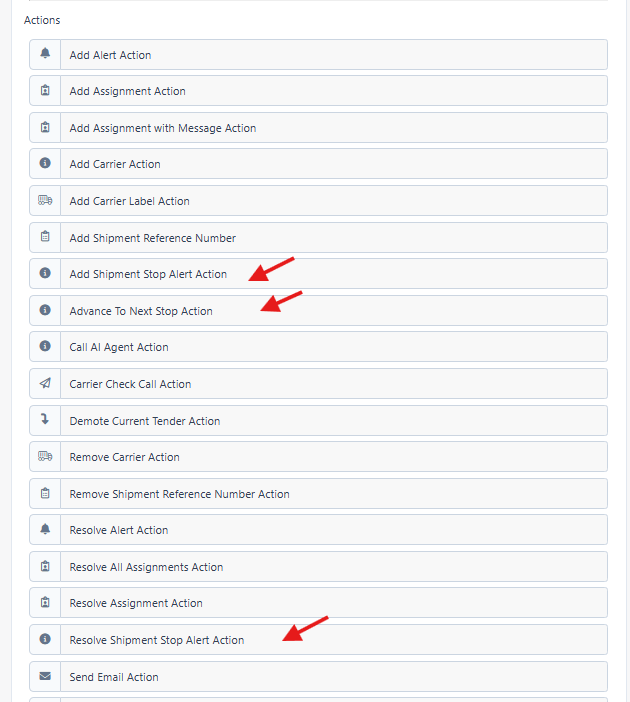
- Combining Advance To Next Stop with Add Shipment Stop Alert lets you propagate an alert forward: resolve on the current stop, advance, then add to the next stop in a single workflow run.
How to report on stop alerts
Where to go: Back Office → Reports → Custom Reports.
- Stop alert data is available in the Custom Reports field picker: Origin Active, Origin Resolved, Destination Active, Destination Resolved, and Additional Stop 1 through 5 (Active and Resolved).
- Each column lists alert names comma-separated when multiple alerts exist on a stop.
How to manage stop alerts through the Public API (Coming Soon)
If your organization integrates with TMS through the Public API, stop alerts can be added, resolved, and retrieved programmatically, in addition to using the Back Office.
- Add one or more alerts to a specific stop.
- Resolve one or more alerts on a specific stop.
- Retrieve all alerts, active and resolved, for a specific stop.
- Alerts added or resolved through the Public API trigger Workflow Automations the same way alerts added in the Back Office do.
Note: Only broker-level API access can add or resolve stop alerts. This matches the Front Office, where customers can view stop alerts but cannot add or resolve them.
Contact our Support team for the endpoint details.
Frequently asked questions
What is the difference between a stop alert and a shipment alert?
A shipment alert applies to the entire shipment. A stop alert is attached to a specific stop, a pickup, delivery, or intermediate location, and is visible in the context of that stop only. Both types can be active on the same shipment at the same time.
Can I use the same alert type for both shipment-level and stop-level alerts?
Yes. Enable the Is Stop flag on any alert type to make it available as a stop-level alert. The flag does not remove it from the shipment-level alert selector.
Can customers add or resolve stop alerts from the Front Office?
No. The Front Office stop alert view is read-only. Only Back Office staff can add or resolve stop alerts.
Do stop alerts update in the Front Office automatically?
Yes. Stop alerts added or resolved in the Back Office are reflected in the Front Office shipment detail page.
Can a Workflow Automation move a stop alert from one stop to the next?
Yes. Use a chain of Resolve Shipment Stop Alert, Advance To Next Stop, and Add Shipment Stop Alert actions in a single workflow. When the workflow fires, it resolves the alert on the current stop, advances to the next stop, and adds the alert there, — all in one run.
Why can't I see an alert type in the stop alert selector?
The stop alert selector only shows alert types with the Is Stop flag enabled. Contact your admin to enable the flag on the alert type you need.