![TAI_LOGO_CMYK Option 1.2-03.jpg]](https://learn.tai-software.com/hs-fs/hubfs/TAI_LOGO_CMYK%20Option%201.2-03.jpg?height=40&name=TAI_LOGO_CMYK%20Option%201.2-03.jpg)
Table of Contents
- How to Access a Carrier Profile
- LSP Carrier Search
- Bulk Operations in LSP Carrier Search
- Carrier Profile Breakdown
- How to Track Contact With a Carrier
- Carrier Rep Contact Notifications
- How to Set a Carrier's Domicile Address
- Contact and Domicile Columns in Carrier Reports
How to Access a Carrier Profile
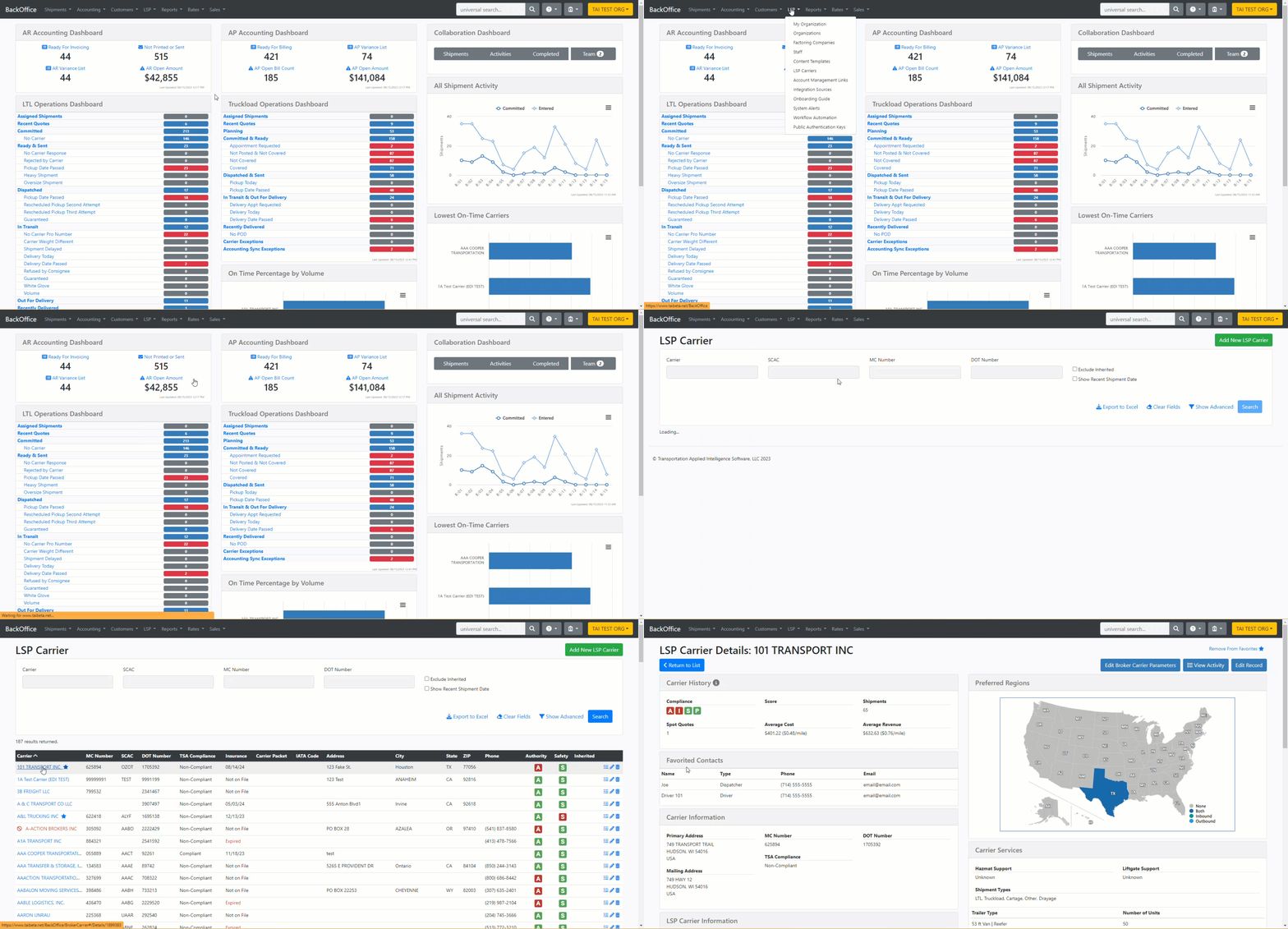
To access a carrier's profile, navigate to the LSP tab and select LSP Carriers. Then, click on the name of the carrier you want to view.
LSP Carrier Search
To locate your carriers more efficiently, you can apply filters under LSP Carriers. These filters include the carrier's name, SCAC, MC Number, and DOT Number. If you need additional filter options, you can click on Show Advanced.

Show Recent Shipment Date and Exclude Inherited
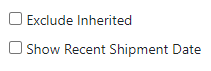
The "Show Recent Shipment Date" filter is a new addition to the LSP Carrier Search feature. Here's how it works:
1. If you select this filter, a new column will be included in the search results.
2. The search will only consider recent shipment dates if you specifically choose this option.
By selecting "Exclude Inherited," you have the option to hide carriers that have been inherited from your parent organization.
Bulk Operations in LSP Carrier Search
The LSP Carrier Search Page allows you to perform bulk actions on multiple carriers simultaneously. This helps streamline carrier management by applying changes across selected carriers with a single action.
Selecting Carriers
-
Each carrier row includes a checkbox on the left.
-
A “Select All” checkbox at the top of the list allows you to select every carrier on the page.
-
Once one or more carriers are selected, the Bulk Operations Panel appears on the right-hand side of the screen.

Bulk Operations Panel
The panel provides options for managing carrier labels, statuses, and shipment types in bulk.

-
Add Carrier Labels – Enter a label → click Add → applied to all selected carriers (if not already present).
-
Remove Carrier Labels – Enter a label → click Remove → removed from all selected carriers (if present).
-
Update Carrier Status – Select Active / Blocked / Disabled → click Update → status applied to all selected carriers.
-
Update Shipment Types – Choose shipment types → click Add → types added to selected carriers (if not already supported).
Insurance Column

The Insurance column in LSP Carrier Search gives you a quick view of a carrier's current coverage status. The column will display one of the following:
- Expiration date — the carrier has at least one active policy. The date shown is the soonest expiration across all active policy types. When date is in yellow, it means the Insurance record is soon to be expired.
- Expired — at least one policy has passed its expiration date with no currently active replacement. This is highlighted in Red,
- Not on File — no insurance records have been added to the carrier's profile.
- Not Yet Active — the carrier has insurance records on file, but all policies have a future effective date and are not yet in force. This is highlighted in Blue.
To see a breakdown by policy type, hover over the Insurance column cell. A tooltip will appear showing each type on file along with its date and status:
- �� Expired policy
- ⚠ Policy expiring soon (within 30 days)
- ⌛ Policy not yet active (pending)
- No icon only date— active policy with more than 30 days remaining
Note: A policy only counts as active coverage if its effective date is today or in the past. A policy with a future effective date will not be treated as active, even if it is already on file.
Insurance Column in Exports
When you export your carrier search results, the file will include three insurance-related columns:
- Insurance Info — matches the Insurance column shown in the search results.
- GL Expiration — shows the expiration date of the most current General Liability policy on file, regardless of whether it is active or expired.
- Cargo Expiration — shows the expiration date of the most current Cargo policy on file, regardless of whether it is active or expired.
Each per-type column (GL Expiration and Cargo Expiration) will display one of the following:
- A date — the expiration date of the most current policy on file for that type.
- Not Yet Active — a policy exists for that type but its effective date has not yet been reached.
- Not on File — no policy of that type has been added to the carrier's profile.
Exceptions: If a policy type is not on file, the corresponding column will show Not on File. If the policy is pending, it will show Not Yet Active
Carrier Profile Breakdown
When you click on the carrier's name, you will immediately gain access to a summary of their profile. This allows you to easily review the carrier's information and upload any necessary carrier documents. If you need to make any modifications to the carrier's information, simply click on the edit option.
Please note that any changes to a carrier’s primary or mailing address cannot be made directly in the system. To request an update, please contact the Tai Support team. Updates will be made only if the information is available and verified through the SAFER web.
Carrier History
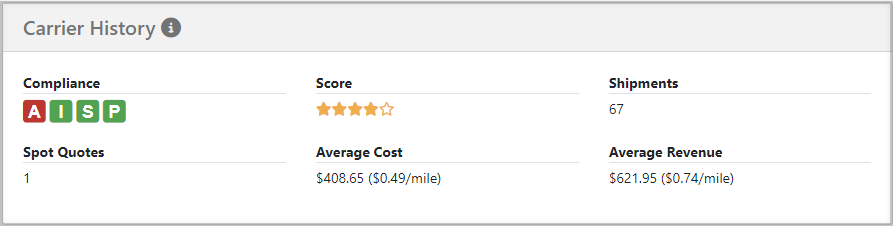
In the carrier history, you can find the Carrier Score, Active Shipments, Spot Quotes, Average Revenue, and Average Cost per mile based on a 12 month history. Active Shipments count includes all shipments between Booked and Completed, while Spot Quotes show the number of quote requests created from the Truckload Quoting page.
Contact Activity
The Contact Activity panel shows the last time anyone on your team was in contact with the carrier. It sits directly below Carrier History, on the carrier's profile page and in the carrier preview that opens when you click a carrier's name elsewhere in the TMS, such as Shipment Details, Truckload Quoting and the Charge Line Summary.
- Last Contacted – the date and time of the most recent contact.
- Contact Type – Email Sent, Email Received, Quote Received or Manual Contact.
- Contacted By – the user on your team the contact is attributed to.
- Never contacted – shown instead of the three values when the carrier has no contact on record.

Contact is recorded automatically as your team works, and you can also log it yourself. For what counts as contact and how to log a call or text, see How to Track Contact With a Carrier.
Authority Compliance Indicator
- Authority data is sourced from CarrierDetails.com
- Green indicates that the carrier's authority is valid.
- The following criteria must be met for the Authority to turn green in a carrier:
- DOT Status = Active
- Common, Broker, or Property Authority = Active
- Note, Intrastate carriers (AKA DOT Only carriers), do not require authority per guidelines on SaferWatch. However, organizations that have the Require Carrier Compliance setting on still need their carriers to meet all compliance indicators.
- Intrastate carriers must be notated within the carrier profile so that the system will mark the Authority as green.

- When the following criteria is met for a carrier, the indicator will turn green:
- DOT Status = Active
- Common Authority = None
- Broker Authority = None
- Property Authority = None
- Intrastate = True

- Intrastate carriers must be notated within the carrier profile so that the system will mark the Authority as green.
- The following criteria must be met for the Authority to turn green in a carrier:
Insurance Compliance Indicator 
- For Insurance within 30 days of expiring, The Insurance Indicators in AISP will turn yellow instead of Green. This acts as a warning that Insurance is soon due to expire.
- If the carrier has multiple types of insurance, the system will check all the insurance types in their profile to ensure that there is an effective date for each one. However, not all types of insurance need to be listed in the profile.
- For example, if a carrier has both an expired Motor Vehicle Insurance and an effective one, the system will display the indicator as green because it checks if there is another active insurance of the same type.

Favorited Contacts
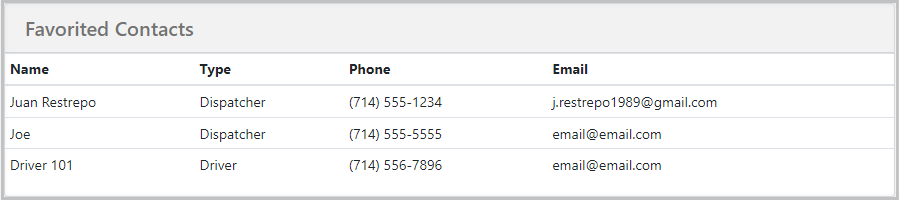
You can choose to mark a contact as a favorite, and it will be displayed in the Carrier Information section. This information will also be easily accessible on the Truckload Quoting Screen, allowing for quick and convenient access for you.
Contact Notes
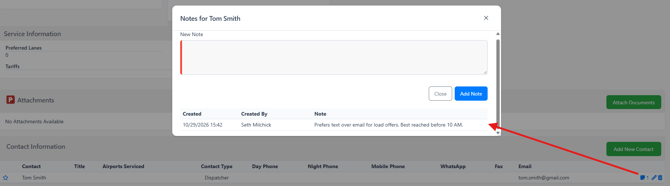
Contact Notes let you keep notes about a specific person at the carrier, not just about the carrier as a whole. For example, "prefers text over email" or "covers the Midwest lanes".
Where to go: LSP > LSP Carriers > click the carrier's name > Contact Information > the note icon on the contact's row.
- Click the note icon next to the contact to open Notes for .
- Type your note under New Note and click Add Note. The newest note appears first, with the date and time it was added and who added it.
- Notes are shared. Everyone in your organization who can open the carrier sees the same notes.
- Notes can't be edited or deleted after they're added, so add a new note if something changes.
Preferred Regions
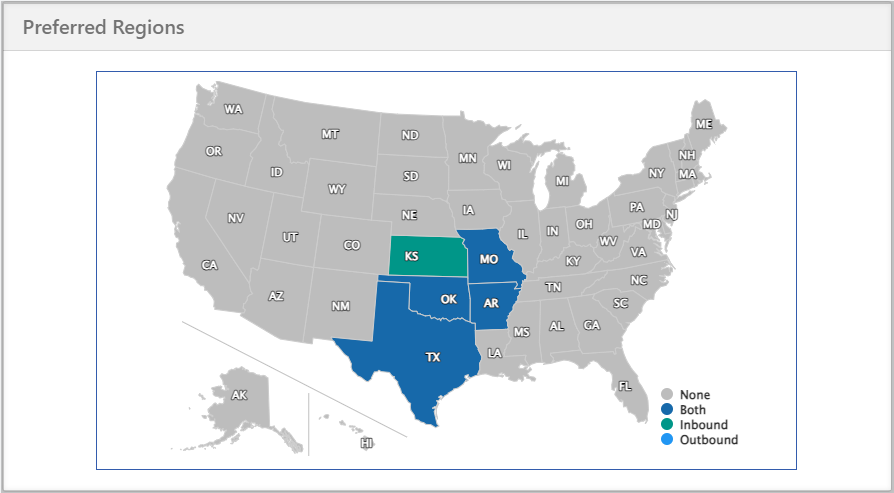
The Preferred Regions section enables users to select the specific states in which the carrier operates and allows for a more detailed and customized use of the carrier's services. Carriers can indicate whether a state is Inbound, Outbound, or Both, resulting in more relevant carrier options being displayed on the Truckload Quoting page when the "Include Region Carriers" option is checked.
Carrier Services
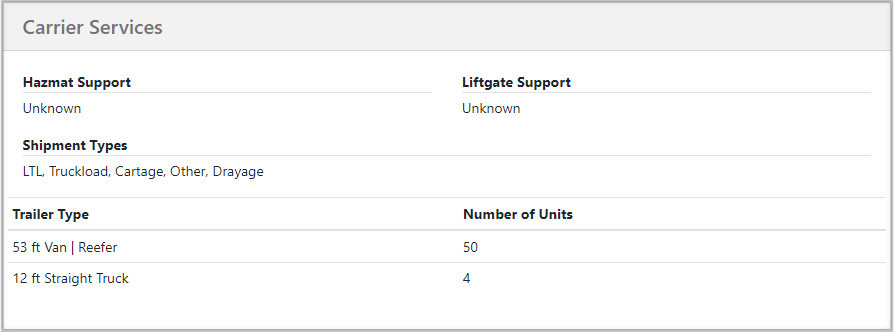
The carrier services section provides a detailed list of the specialized services offered by the carrier, along with the types of equipment they have available. This important information is also easily accessible on the Truckload Quoting Screen, allowing you to quickly assess the carrier's capabilities and services when preparing a shipment quote.
Accounts Payable
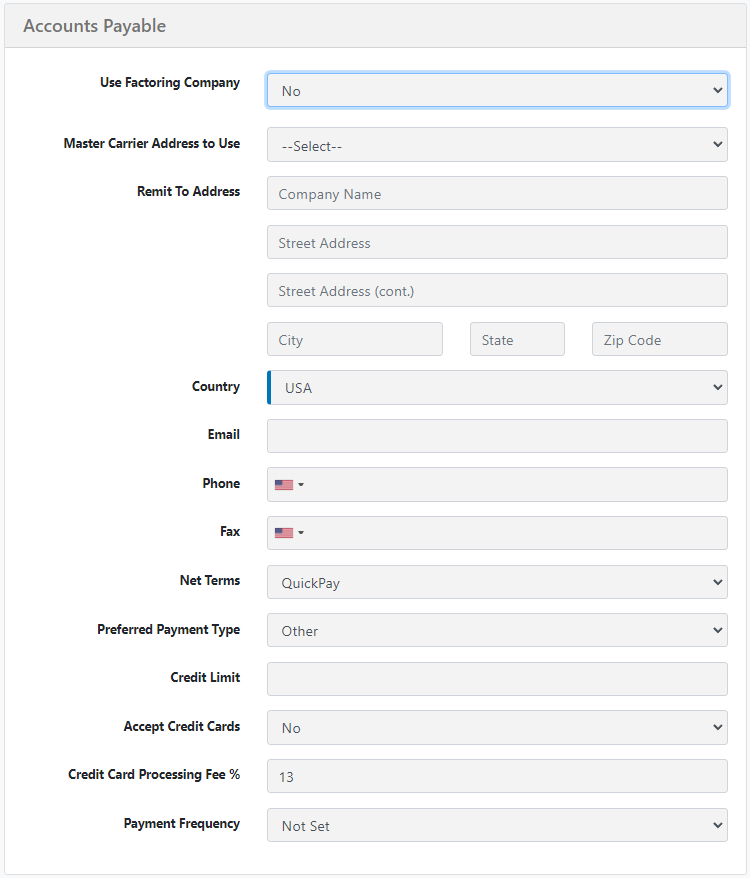
When a new LSP Carrier is added to the TMS, the payment terms will default to 30 days.
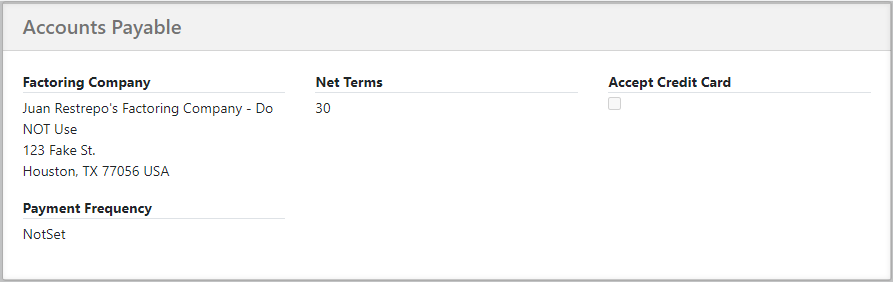
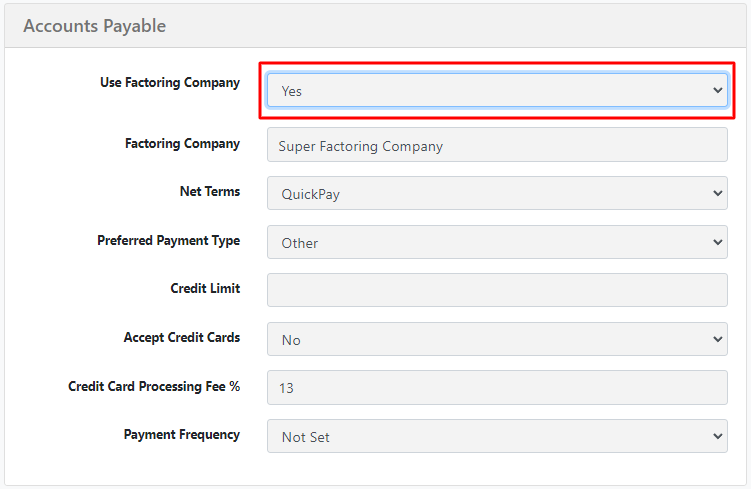
The account payable section allows you to register if a carrier uses a factoring company and add their remit to address, email, phone number, and fax. Also, you can select the Net terms for the payments between 7, 15, 30, 45, and Quick Pay, as well as the preferred payment type. You can set a credit limit for the carrier, select if they accept credit cards, and choose a processing fee percentage. The last option is the payment frequency, where you can choose between not set, weekly, or monthly.
***Note: Whenever a carrier has the QuickPay option selected under their net terms, you will see this reflected when approving the bills as a checkmark on the bill you have pending approval. For more information, see Approve Bills***
Domicile Address
The domicile address is the carrier's home base: where its trucks are based, which can differ from its primary (physical) and mailing addresses. When a domicile address is saved, the Carrier Information section shows Domicile Address, along with Domicile Email and Domicile Phone if you entered them. The same details appear in the carrier preview opened from a shipment.
- If no domicile address has been saved, the Domicile Address fields don't appear at all.
- To add or change it, see How to Set a Carrier's Domicile Address.
LSP Carrier Information
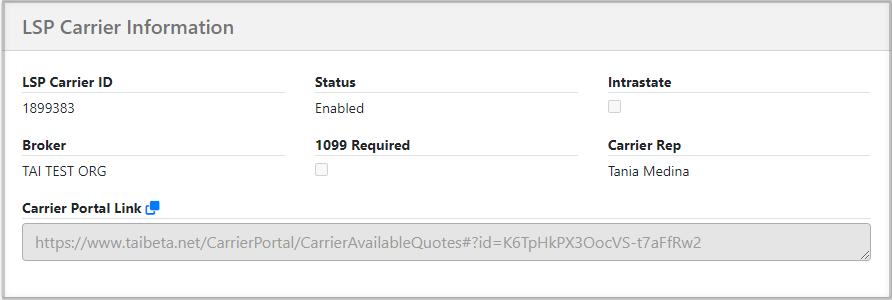
In this section, you will find the LSP Carrier ID, the status of the carrier, their support for Intrastate operations, the organization they belong to, if they are required to file a 1099 form, the assigned Carrier Representative, and the unique link to their carrier portal. The Carrier Representative is also emailed when someone else on the team contacts their carrier. See Carrier Rep Contact Notifications.
How to Track Contact With a Carrier
The TMS records each contact with a carrier in the carrier's Activity Log, and the most recent one appears in the Contact Activity panel. Most contact is recorded automatically. You only need to log calls, texts and other contact that happens outside the TMS.
What is recorded automatically
- Email Sent – when you email the carrier a quote request from Truckload Quoting, or when a rate confirmation or carrier confirmation email is sent to the carrier.
- Email Received – when the carrier replies to one of those emails. It's attributed to the user who sent the original email and dated by when the reply was received.
- Quote Received – when a carrier quote is added in Truckload Quoting. Editing an existing carrier quote also records a new Quote Received.
Other emails to the carrier, such as waterfall tender emails, documents sent with Document Sender, and messages sent with Send Message, are not recorded as contact. Log them as a Manual Contact if you want them to count.
How to log a call, text or other contact (Manual Contact)
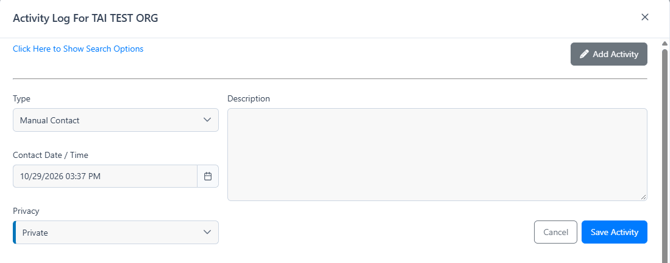
Where to go: LSP > LSP Carriers > click the carrier's name > View Activity > Add Activity.
- Type – choose Manual Contact.
- Contact Date / Time – fills in with the current date and time. Change it if the contact happened earlier. Future dates aren't allowed.
- Privacy and Description – add a short description, such as "Called dispatch, truck available Tuesday".
- Click Save Activity. You'll see "Activity added successfully!", and the entry appears in the log in date order.
- Close the Activity Log to see the Contact Activity panel update.
How Last Contacted is chosen
- Last Contacted is always the contact with the most recent date and time, whatever its type.
- If you log a Manual Contact with an earlier date, it's added to the history but won't replace a newer contact in the panel.
- Contact stays attributed to the user who made it, even if that user is later made inactive.
- If your organization has sub-organizations, the Contact Activity panel and Activity Log also include contact recorded by users in those sub-organizations, except sub-organizations that do their own invoicing. Users in a sub-organization don't see contact recorded by the parent organization.
Carrier Rep Contact Notifications
When a carrier has an assigned Carrier Rep, the rep gets an email whenever someone else on the team records a contact with that carrier, so the rep always knows who's talking to their carriers.
Where to go: to assign a rep, open the carrier and click Edit Record, then choose the user in Carrier Rep. The rep shows under Carrier Information.
- The email subject is Contact recorded with your carrier [carrier name]. The email says who recorded the contact and gives the contact type, date, the carrier's MC# and DOT# when they're on file, and the description.
- It's sent for every recorded contact type, including a carrier quote being added or edited, so each quote edit sends another email.
- No email is sent when the rep records the contact themselves, or when the carrier has no Carrier Rep.
- The Carrier Rep is for awareness only. It doesn't limit who can see or work with the carrier.
- The email goes to the rep's email address on their user profile and comes from your organization's usual system email sender. No email is sent if the rep has no email address or is inactive.
How to Set a Carrier's Domicile Address
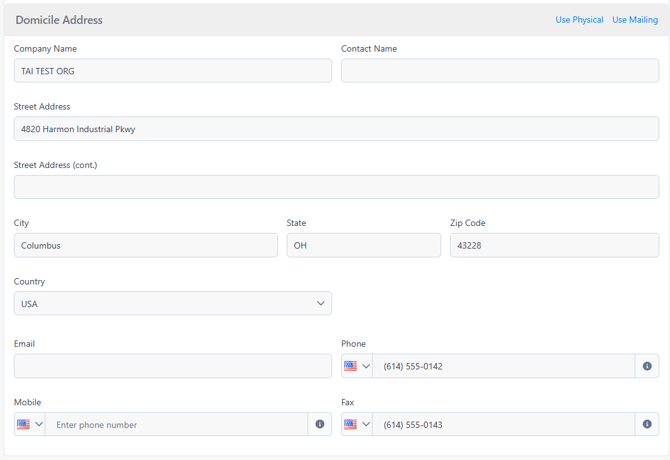
You set a carrier's domicile (home-base) address when editing the carrier. You can type it in or copy the carrier's physical or mailing address.
Where to go: LSP > LSP Carriers > click the carrier's name > Edit Record > Domicile Address panel.
- Fields: Company Name, Contact Name, Street Address, Street Address (cont.), City, State, Zip Code, Country, Email, Phone, Mobile and Fax.
- Use Physical – copies the carrier's physical address, carrier name, phone and fax into the domicile fields.
- Use Mailing – copies the carrier's mailing address, carrier name and mailing phone and fax into the domicile fields.
- Click Save & View Details. The carrier profile opens with the domicile shown under Carrier Information. No confirmation message appears when the save succeeds.
- To remove a domicile address, clear every Domicile Address field and save.
Use Physical and Use Mailing make a one-time copy. If the carrier's physical or mailing address changes later, the domicile address doesn't change with it, so update it yourself if needed. Copying also replaces anything already typed in the Company Name, Phone and Fax fields.
- The Domicile Address panel is on the edit page only, so add the domicile after the carrier has been created.
- Each change to the domicile address is recorded in the carrier's Activity Log, for example "Domicile City changed from Columbus to Dayton".
Contact and Domicile Columns in Carrier Reports
Carrier custom reports can include each carrier's last contact and domicile address, so a manager can find carriers nobody has been in touch with recently.
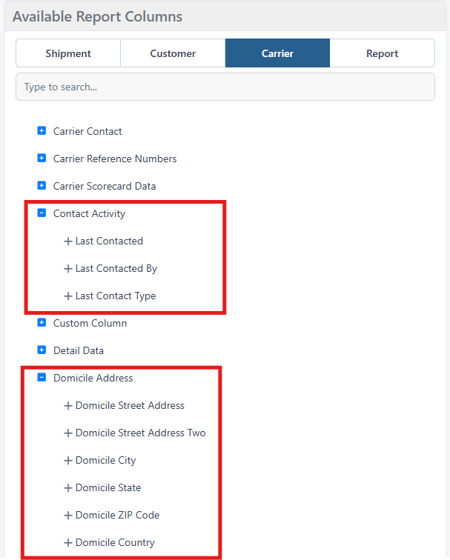
Where to go: Reports > Custom Reports > Add New Report > choose Carrier > Available Report Columns.
- Contact Activity group – Last Contacted, Last Contacted By and Last Contact Type.
- Domicile Address group – Domicile Street Address, Domicile Street Address Two, Domicile City, Domicile State, Domicile ZIP Code and Domicile Country. Carriers without a domicile show these cells blank.
- General Information group – Carrier Rep, to see who owns each carrier.
How the report's Last Contacted differs from the carrier page
- The report counts outgoing contact only: Email Sent and Manual Contact. Quote Received and Email Received don't count, so the report can show an older date than the Contact Activity panel. A carrier whose only contact is quotes shows blank Last Contacted cells.
- Report dates and times use your time zone's standard time, as the note at the top of the report says. During daylight saving time they show one hour earlier than the carrier page.
How to find carriers you haven't contacted recently
- Add a filter on Last Contacted and choose a range such as More than 30 Days Ago or More than 90 Days Ago.
- Carriers that have never been contacted have no Last Contacted date, so a date filter leaves them out. To find them, build the report without the date filter and use Add Sorting on Last Contacted so the blank rows sit together.
Carrier Contact: Frequently Asked Questions
Why did Last Contacted change when I only edited a carrier quote?
Saving a change to a carrier quote records a new Quote Received contact, the same as adding a quote. If the carrier has a Carrier Rep, the rep is also emailed.
I logged a call with an earlier date. Why isn't it showing as Last Contacted?
Last Contacted always shows the most recent contact. A Manual Contact dated earlier than an existing contact is saved in the Activity Log but doesn't replace the newer one.
Why does the report show a different Last Contacted than the carrier page?
The report counts only outgoing contact (Email Sent and Manual Contact), and it shows times in standard time. The carrier page counts every contact type in your local time.
I sent the carrier an email. Why doesn't it count as contact?
Only quote request, rate confirmation and carrier confirmation emails are recorded automatically. For any other email, log a Manual Contact.
Why don't I see a Domicile Address on the carrier's profile?
The Domicile Address only appears once one has been saved. Add it from Edit Record > Domicile Address.