![TAI_LOGO_CMYK Option 1.2-03.jpg]](https://learn.tai-software.com/hs-fs/hubfs/TAI_LOGO_CMYK%20Option%201.2-03.jpg?height=40&name=TAI_LOGO_CMYK%20Option%201.2-03.jpg)
Overview
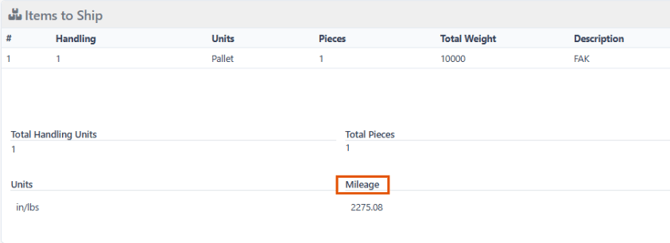
Tai calculates the mileage on your shipment automatically. It uses PC-MILER "truck miles," based on the origin and destination ZIP codes you enter. The mileage shows up right away in the Commodity section you don't have to enter it yourself. (See image below)
User Guide
Before you start
- Enter an origin and destination ZIP code on the shipment. (If your organization uses Address-to-Address routing, enter full addresses instead.)
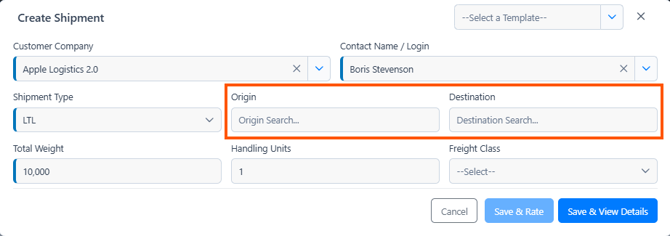
How to view your shipment's mileage
Where to go: Shipment > Commodity section.
- Enter your origin and destination ZIP codes and create the shipment. The mileage appears in the Commodity section.
How to use the Mileage Calculator
Where to go: On the shipment, next to the Mileage field.
- Click the calculator icon next to the Mileage field.
- Pick a routing type:
Practical (a realistic driving route, using common roads) or
Shortest (the least distance possible, any road type).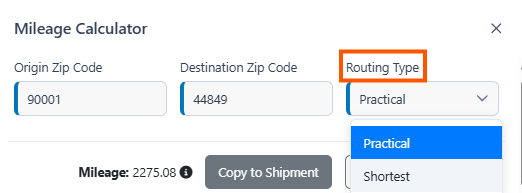
- Compare the two before you apply a value to the shipment.
How to set a fixed mileage for a customer's lane
Where to go: Customers > Companies > Choose a company > Customer Tools
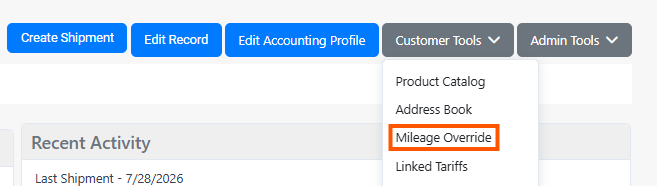
On the Customer Mileage Override screen, you can view and manage all existing mileage overrides, including editing or deleting them.

To create a new override, click the green Add New Mileage Override button.

After clicking Add New Mileage Override, enter the Origin ZIP Code, Destination ZIP Code, and the agreed-upon mileage for that lane. This mileage will override the standard PC-MILER calculation and be used instead for shipments matching that customer and lane.
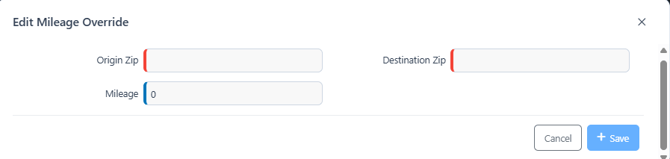
If you need to add multiple overrides for the same customer, click Import/Export.

First, download the import template, then fill in the required information and save the file to your computer.
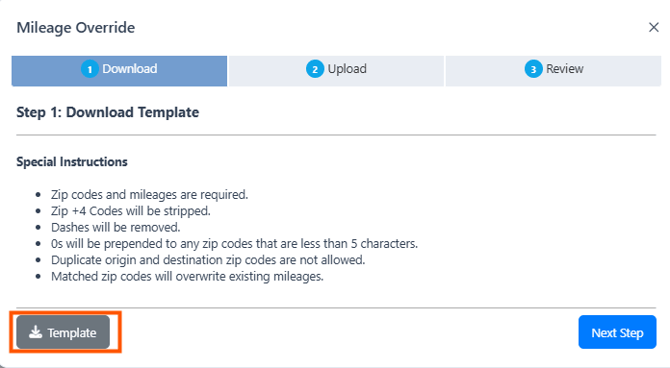
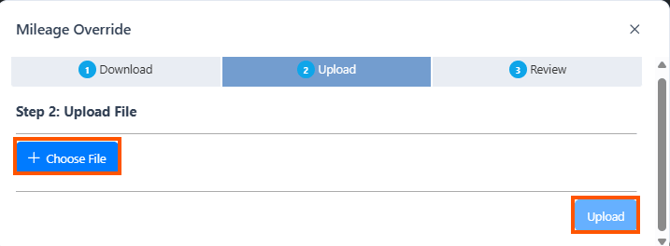
Finally, click Import, select Next Step, choose the completed file from your computer, and then click Upload to finish the import process. This will add all mileage overrides at once instead of requiring you to create them individually.
When to use a mileage override
Some common scenarios where a fixed mileage makes more sense than the standard calculation:
- Customer agreement: Your contract with the customer specifies an agreed-upon mileage for a lane, regardless of what PC-MILER calculates.
- Construction: Ongoing roadwork changes the practical route, but you want to keep billing consistent on that lane.
- Seasonal road closures: A route is only affected part of the year, so you want a mileage that reflects the detour while it's in effect.
- Weather-related detours: Recurring weather conditions push trucks onto a longer or shorter route than the standard calculation assumes.
- Any other recurring condition that makes the standard calculated route unsuitable for that specific lane.
Tips & best practices
- A small difference between Practical and Shortest mileage is normal, they're different routes, not an error.
- If your organization has its own PC-MILER integration, ask your admin if Address-to-Address routing is turned on. It's usually more accurate, but the number may look different than what you're used to.
- Use Customer Mileage Override only for that one lane — it's not a general fix.
Frequently asked questions
-
Why is my mileage different from another system? Different systems use different routing methods, so small differences are normal and usually not an error.
-
Can I set a fixed mileage for one customer's lane? Yes. Use Customer Mileage Override. It takes over for that lane only.
- When should I use a mileage override instead of the standard calculation? Use it when a lane needs a fixed number that differs from PC*MILER's calculation — for example, a customer agreement with an agreed-upon mileage, ongoing construction, seasonal road closures, recurring weather detours, or any other lasting condition that makes the standard route unsuitable.
- What's the difference between Practical and Shortest routing? Practical uses common roads for a realistic route. Shortest is just the least distance, on any road. They can give different mileage for the same trip.
- Can I use street addresses instead of ZIP codes? ZIP-to-ZIP is the default. If your organization has its own PC*MILER integration, your admin can turn on Address-to-Address for more precise mileage.
If something doesn't work
- Check that the ZIP codes (or addresses) on the shipment are correct. This is the most common cause of unexpected mileage.
- Compare Practical and Shortest routing in the Mileage Calculator. A difference here isn't necessarily an error.
- Still looks wrong for one customer's lane? Ask your admin about a Customer Mileage Override.
- Still not resolved? Contact Tai support with the shipment or lane details.