![TAI_LOGO_CMYK Option 1.2-03.jpg]](https://learn.tai-software.com/hs-fs/hubfs/TAI_LOGO_CMYK%20Option%201.2-03.jpg?height=40&name=TAI_LOGO_CMYK%20Option%201.2-03.jpg)
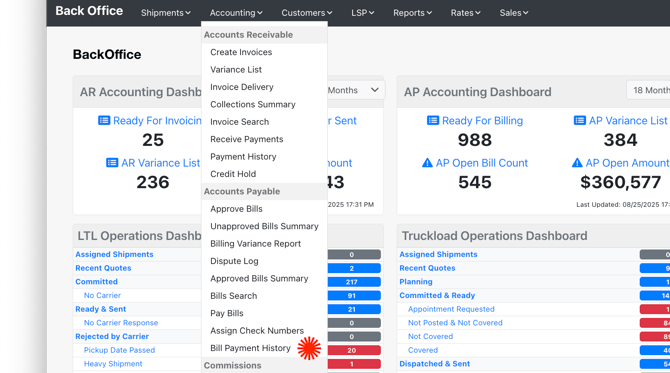
- Bill Payment History will display Payments (checks/ACH) that have been cut to vendors or carriers in the system.
- Our Search Criteria or filters will allow you to quickly sort the information by:
- Vendor Name
- Payment Time - ACH, Cash, Check, Credit Card, EFS, or Other.
- Open Balance - Yes or No.
- Date Range - 7 days ago, 30 days ago, 60 days ago, No data range, or custom, which will allow you to enter your own date parameters.
- Check Number - open text field where you will be able to manually enter the check number.
- Processing Status - Error, Paid, Processing, Refund, Scheduled, Void.
- Advanced Payment - All, Applied, Unapplied
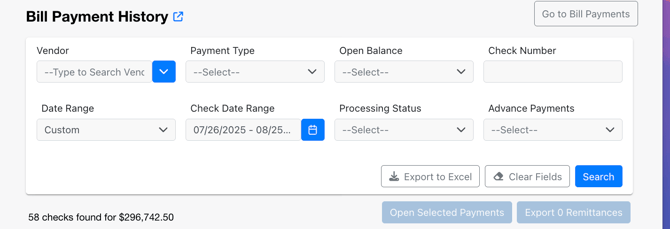
- Vendor Name
- By default, the page will list the most recently cut checks. In addition, you can view different columns comprising the most important details of a bill, such as:
- Vendor Name
- Check Date
- Check Number
- Check Memo
- Payment Type
- Processing Status
- Amount
- Number Applied to
- Sync Date
- Alerts
- You will be able to click on any of the above columns to change from a descendant to an ascendant order, or vice versa.
- By clicking on the values in the Number Applied To column, you will be redirected to the specific bill payment.

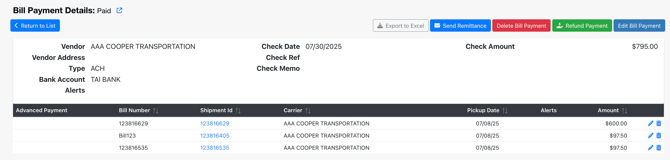
- Inside the Bill payment details, you should be able to:
- Send the Remittance to the carrier or a specific recipient as an email with an Excel attachment.
- See the Send Remittance section below for details.
- Send the Remittance to the carrier or a specific recipient as an email with an Excel attachment.
-
- Delete Bill Payment
- Refund payment
- Edit the bill payment details.
- The red exclamation point icon helps to alert you to any bills that have an open balance
- Lastly, if by any chance you need specific information about the Bill payment history page, there is the option to Export to Excel, which will allow you to have the same information on a spreadsheet to share with your team.
Send Remittance
Use Send Remittance to email a structured remittance document to a single carrier (or factoring company) contact directly from the TMS. It is the single-payment counterpart to the bulk Export Remittances workflow.
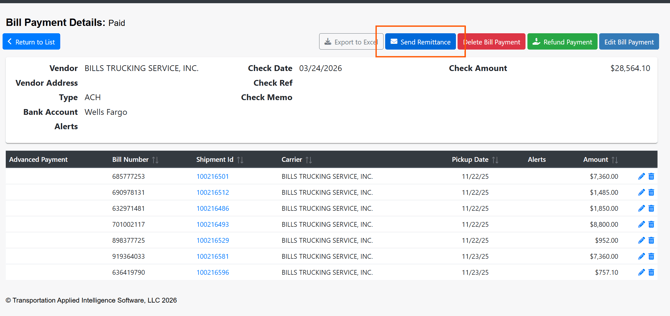
Where to find it
Accounting > Bill Payment History > click the “Number Applied To” link for the payment > on the Bill Payment Details page, use the Send Remittance action.
What you provide
- Recipient Email. The carrier or factoring-company contact who should receive the remittance.
- Include Me on CC. Optional. When checked, your own email address is added to the CC line so you retain a copy of what was sent.
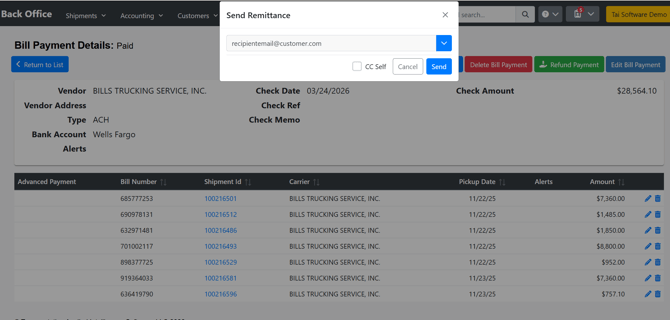
What the recipient receives
- Subject line. Your organization name followed by the total check amount formatted as currency.
- Body. A formatted summary containing the vendor name and address, payment type (Check, ACH, Credit Card, EFS, HaulPay, and so on), check date, check reference, check memo, and check amount.
- Attachment. An Excel workbook named
CheckRemittance_{Vendor}_{Reference or Date}.xlsxlisting each applied bill with Bill Number, Shipment ID, Carrier (for carrier or factoring-company vendors), Pickup Date, and Amount.
When to use Send Remittance vs Export Remittances
- Send Remittance (this action). One payment, one carrier, emailed directly from the TMS. Best for ad-hoc requests or small payment runs.
- Export Remittances. Bulk spreadsheet covering many selected payments at once, for offline processing. Best for weekly or monthly reconciliation. See https://learn.tai-software.com/knowledge/export-remittances.
Troubleshooting
- Confirm the recipient email address is correct and not blocked by the recipient’s spam filter. Ask them to check junk folders for a message from your sending domain.
- Confirm the sending user has an email sender identity configured on the LSP site profile. Without one, the email cannot be dispatched.
- If the attachment link is broken in the received email, the temporary blob may have expired. Re-sending generates a fresh attachment.
- For carriers with a factoring company, verify the remittance is going to the right contact; factored carriers typically receive remittance at the factoring company address.
- If the body has blank fields (check memo, check reference), those fields were blank on the bill payment record. The email reflects exactly what was saved.